Showing posts with label Stars and Constellations. Show all posts

CONSTELLATIONS AND THEIR NAMES

Lucet Stellae


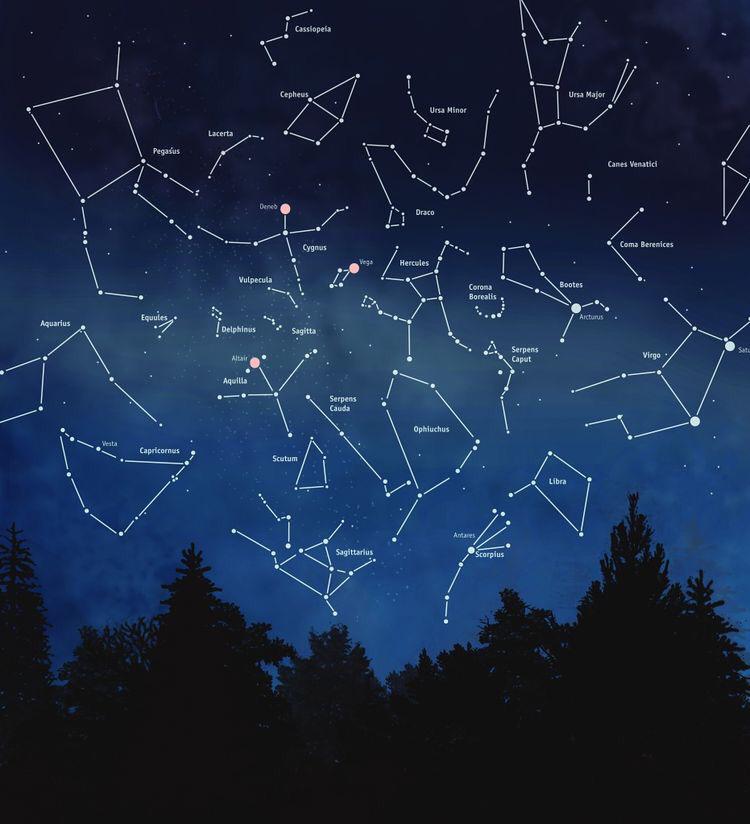
As we now know some basic detailing about stars and some of the myths, now let’s move on to some major stars and star constellations. As we now know that there are 88 recognised star constellations by International Astronomical covering the entire Southern and Northern sky, let’s learn more about each constellations and it’s specifics. 

Nomenclature of constellations are mostly Latin but their origin differs in time and spaces. Some constellations like scorpius is originated from the Latin word Scorpion,  but it was commonly known as "IP", the Scorpion King, to the Egyptian people from before 3000 B.C.

Given below are all the star constellations according to their Latin as well as their English standard naming

Alphabetically the naming goes as :-

Latin Name    English Name or Description

Andromeda                - Princess of Ethiopia

Antlia                    - Air pump

Apus                    - Bird of Paradise

Aquarius                    - Water bearer

Aquila                    - Eagle

Ara                            - Altar

Aries                    - Ram

Auriga                    - Charioteer

Bootes                    - Herdsman

Caelum                    - Graving tool

Camelopardalis.         - Giraffe

Cancer                    - Crab

Canes Venatici.          - Hunting dogs

Canis Major            - Big dog

Canis Minor            - Little dog

Capricornus            - Sea goat

Carina                    - Keel of Argonauts' ship

Cassiopeia            - Queen of Ethiopia

Centaurus            - Centaur

Cepheus                    - King of Ethiopia

Cetus                    - Sea monster (whale)

Chamaeleon            - Chameleon

Circinus                    - Compasses

Columba                    - Dove

Coma Berenices         - Berenice's hair

Corona Australis    - Southern crown

Corona Borealis         - Northern crown

Corvus                    - Crow

Crater                    - Cup

Crux                    - Cross (southern)

Cygnus                    - Swan

Delphinus            - Porpoise

Dorado                    - Swordfish

Draco                    - Dragon

Equuleus                    - Little horse

Eridanus                    - River

Fornax                    - Furnace

Gemini                    - Twins

Grus                    - Crane

Hercules                    - Hercules, son of Zeus

Horologium            - Clock

Hydra                    - Sea serpent

Hydrus                    - Water snake

Indus                    - Indian

Lacerta                    - Lizard

Leo                            - Lion

Leo Minor            - Little lion

Lepus                    - Hare

Libra                    - Balance

Lupus                    - Wolf

Lynx                    - Lynx

Lyra                            - Lyre or harp

Mensa                    - Table mountain

Microscopium            - Microscope

Monoceros            - Unicorn

Musca                    - Fly

Norma                    - Carpenter's Level

Octans                    - Octant

Ophiuchus                  - Holder of serpent

Orion                    - Orion, the hunter

Pavo                    - Peacock

Pegasus                    - Pegasus, the winged horse

Perseus                    - Perseus, hero who saved Andromeda

Phoenix                    - Phoenix

Pictor                    - Easel

Pisces                    - Fishes

Piscis Austrinus.        - Southern fish

Puppis                    - Stern of the Argonauts' ship

Pyxis                    - Compass on the Argonauts' ship

Reticulum            -  Net

Sagitta                    - Arrow

Sagittarius            - Archer

Scorpius                    - Scorpion

Sculptor                    - Sculptor's tools

Scutum                    - Shield

Serpens                    - Serpent

Sextans                    - Sextant

Taurus                    - Bull

Telescopium            - Telescope

Triangulum            - Triangle

Triangulum Australe  - Southern triangle

Tucana                     - Toucan

Ursa Major             - Big bear

Ursa Minor             - Little bear

Vela                             - Sail of the Argonauts' ship

Virgo                     - Virgin

Volans                     - Flying fish

Vulpecula             - Fox


Stay tuned for more updates

ANSU- STAR TRACKER

How Pyramids related to stars ?

Lucet Stellae


It is said that civilisations worshipped god and that they believed that Gods came from Stars from far away. Egyptians have always been a great part in history and also had major myths and stories. Their Gods have been very different and non-human in looks compared to other civilisations.


There is a great theory about the mystery of the Giza pyramid complex. The biggest of the pyramids are built in a certain way that they resemble as the belt of the “Star Constellation of Orion” also known as “Orion Belt”. This theory was put forward by Robert Bauval and was published in 1989. 

 
The three major pyramids are exactly aligned and angled to that of the Orion belt. It is said that the original builders traced the Orion from sky but with  precession of equinox (gradual movement of celestial objects, the positioning changed over millions of years) the position of earth changed, changing the position of the constellation. The Orion constellation hence changed in position from that of how it appeared before 10,000 BC, due to change in earth’s equinox.

It is also said that the Great Sphinx of Egypt which the biggest single stone sculpture in the world was made in the positioning of the constellation of Leo. When the Great Sphinx and the biggest of the Giza Pyramids are matched along with the Nile river, it appears to be a map of constellation of the Leo, the Orion belt along with Nile being considered as the Milky Way galaxy.


It is said that all these were constructed as a trace of the sky on earth but due the precession of the equinox, over thousands of years, it appears to us as just a trace of the attempts to reconstruct the sky and galaxy on earth but considering the precession, it was really excellent of the ancestors to have constructed such marvellous monuments with such accuracy. Also the pyramids are considered as tombs but there is another theory that the pyramids had a kind of patterned ventilation which on one side pointed to the pole star and on the other pointed towards the Orion belt. The construction is so accurate that the ancient people were able to closely evaluate the pole star and thus navigated through the dry lands. 

Stay tuned for more updates 
Star Tracker !!
- ANSU P KUMAR

STARS AND CONSTELLATIONS

Lucet Stellae

* What are stars?

* What are Constellations?


STARS

Stars are luminous hot balls of plasma with their own gravitational force. They appear to us as beautiful tiny illuminated dots in the sky at night. There are basically a few stars commonly known to us , eg. The Sun, the pole star etc. But that is just two among trillions or infinite of them. Our astronomers have been studying on multiple aspects of stars which also include shooting stars as well. There is an entire list of important stars comprehended in Star Catalogue which includes proper identification of stars as well as their features. 


When keen to know about stars there are multiple aspects we can consider apart from its distance, spherical aspects and masses. Humans are yet now considered as the most intelligent being and are thriving with the research on astronomical aspects but when we revisit the history, there are multiple controversial impressions of astronomy - human connection. Many civilisations have been using the astral signs and positions ( Constellations) to navigate through unknown lands and have flourished as well as diminished to earth. Astral aspects like shooting stars were a part of religious believes and were considered bad omens by many civilisations. Leading on the path of stars, civilisations started worshipping what they were afraid of or were incapable of understanding; often powerful stars like Sun was worshipped and even some Constellations like 'the Orion' were worshipped, on the other hand falling stars or shooting stars were often considered bad omen and that they were followed by plague, famine and doom. So are we taken to the bigger group of stars, so called 'Constellations'.


CONSTELLATIONS

Constellations are a group of stars in a particular celestial sphere which are often named on the basis of anecdotes and myths forwarded by many historic civilisations. The obvious question related to constellation is the total number constellation in our universe. But the answer needs to be limited to only those which are officially identified and recognised i.e. eighty eight constellations. 

The word constellation is derived from the Latin word Constellatio, which means “Set of Stars”. The locating and naming process of such group of stars is known as  “Asterism”. This can be traced back to the time before “Before Christ” period. 

But again the question remains that how were they able to do it?


Stay tuned for more updates!!!!


-Ansu P Kumar